
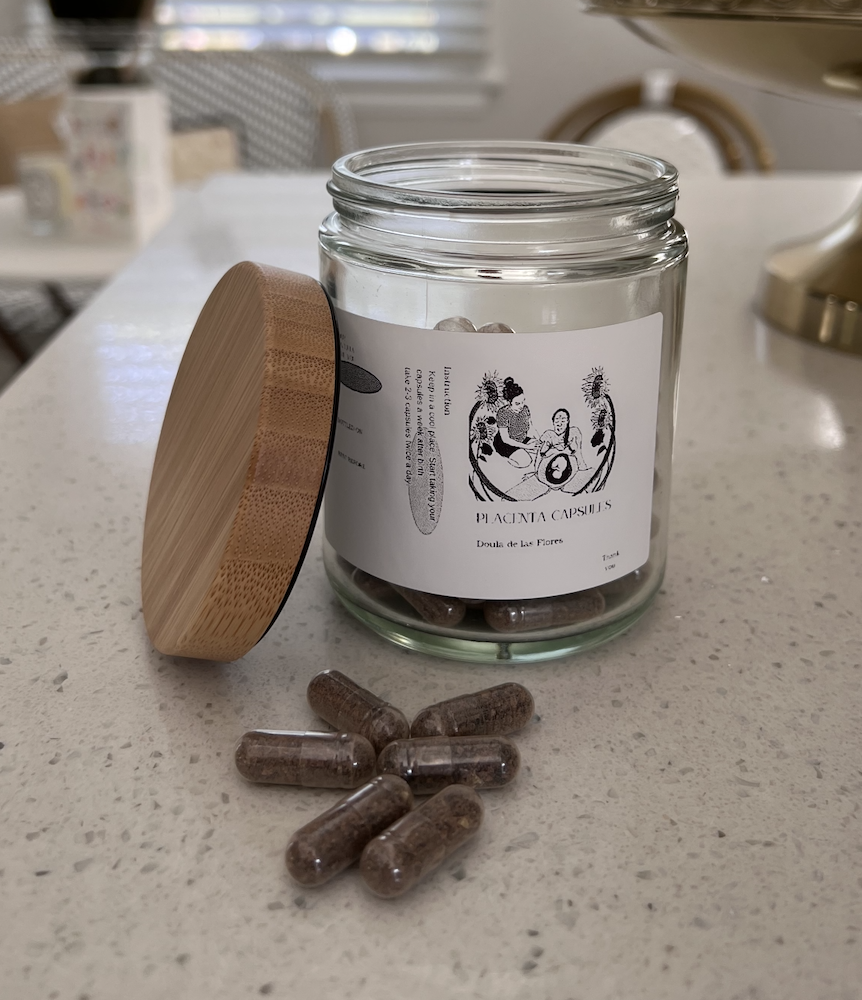
The third stage of labor is the delivery of the placenta. For most of us, you don’t fully remember this stage because as you are delivering your placenta, you are usually holding your son or daughter. At least that was the case for me—except that I did feel like my placenta was never ending. It seemed like the nurses kept pulling and pulling and pulling before my placenta was finally all the way out.
After the placenta is delivered, a lot of women are now having their placenta encapsulated and are taking their placenta post-partum like a supplement. There isn’t a ton of evidence-based trials on the exact benefits of taking your placenta, but almost all other mammals consume their placenta after birth. And it is becoming more common for women to do the same. Many believe that there are so many health benefits to consuming your placenta, and I had decided I would one hundred percent be consuming mine—assuming my placenta was healthy once delivered. Luckily, mine was.
What is your placenta?
The placenta is a temporary organ that the female body creates when pregnant. It is actually the only temporary organ our bodies create and that our bodies are able to recreate for each pregnancy. The female body is truly remarkable in that way. And don’t even get me started on how amazing and magical it is that we are literally able to create life, and it is something only women can do. Anyways, enough about that. The placenta’s job is to deliver nutrients and oxygen to your baby. It is filled with vitamins and minerals, including B6, B12, and iron and hormones, such as, testosterone, progesterone, and estrogen.

So, what are the benefits of consuming your placenta?
It is hard to clearly determine what the actual benefits of consuming your placenta are because everyone is different, and every birth is different. So, no one has been able to really pinpoint and quantify the benefits. Many people believe that consuming your placenta decreases the likelihood of postpartum depression, anxiety, obesity disorders and the like, stabilizes your mood, increases your milk supply, and helps restore the vitamins and minerals and hormones you lost during your labor and delivery, including iron, progesterone and estradiol. I suspect the restoration of the vitamins and minerals is what helps your postpartum mood and milk supply, but I am not a doctor.
My doula was able to make 108 pills from my placenta, so it took a long time to finish them. I can’t say whether or not I was going to have post-partum depression or mood disorders or a low milk supply if I did not encapsulate and take my placenta. But, for what it’s worth, I didn’t have postpartum depression or any mood disorders, and I had a strong milk supply. I also was able to restore all of the vitamins and minerals I lost during my labor and delivery; I think that says a lot since I did hemorrhage during my delivery. I lost a ton of blood, so much so, that the doctors thought maybe I needed a blood transfusion. However, I do take grass fed beef liver religiously, as well, so I am not sure if what I lost was restored due to the beef liver or my placenta pills. I am not sure what I can attribute to my placenta and what would have occurred regardless, but my thought is that if it doesn’t hurt and your placenta is in good shape after your delivery, why not encapsulate it and take your placenta. It can only benefit you. And, I think our placentas are worth a ton on the black market, so if that’s the case there has got to be some real benefit.
So, how do you consume your placenta?
Typically, once you have delivered your placenta, your placenta is put on ice. Then, your placenta is steamed with some sort of natural and antimicrobial herbs, then dehydrated. After the placenta is dehydrated, it is then ground into a pounder and put into capsules. Then, you consume the capsules. The most important part when consuming your placenta is ensuring that a trustworthy person or company is encapsulating your placenta, so that you can avoid contamination or risk of bacteria.
Here’s to being well preserved.
Always,
Taylor


